What Is the Universal Declaration of Human Rights? The Women and Men Who Wrote It
Adopted in Paris on 10 December 1948, the declaration set out for the first time the rights every person holds. Women delegates changed its very words.
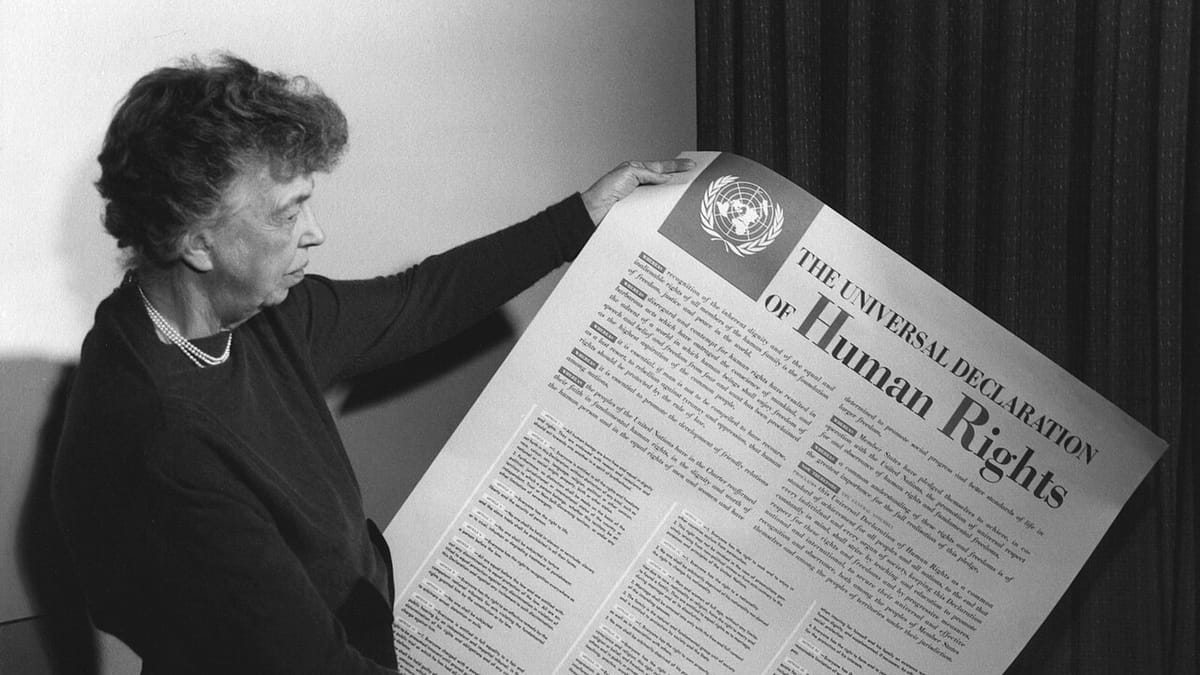
In brief: The Universal Declaration of Human Rights (UDHR) is a document adopted by the United Nations General Assembly in Paris on 10 December 1948. Its 30 articles set out civil, political, economic, social and cultural rights that belong to every person "without distinction of any kind". It is not itself a binding treaty, but it inspired dozens of binding agreements and national constitutions. The date of its adoption is marked every year as Human Rights Day.
Why it was written
The Second World War and the Holocaust showed the world what can happen when states are free to treat people as they wish. The United Nations Charter of 1945 referred to human rights but did not define them. In 1946 the UN created a Commission on Human Rights to draft an international bill of rights.
The drafters
The commission was chaired by Eleanor Roosevelt, the former US First Lady, whose diplomacy helped hold the process together. Key contributors included René Cassin of France, Peng Chun Chang of China, Charles Malik of Lebanon and John Humphrey of Canada, who prepared the first draft for the UN Secretariat.
The women who changed the words
Women delegates made decisive contributions:
- Hansa Mehta of India is credited with changing the phrase "All men are born free and equal" to "All human beings are born free and equal" in Article 1.
- Minerva Bernardino of the Dominican Republic argued for including "the equality of men and women" in the preamble.
- Begum Shaista Ikramullah of Pakistan, one of the first women in Pakistan's Constituent Assembly, was a delegate to the General Assembly's Third Committee and supported language on equal rights in marriage, which became part of Article 16.
The vote
The General Assembly adopted the declaration as Resolution 217 A at the Palais de Chaillot in Paris on 10 December 1948. Forty-eight countries voted in favour, none against, and eight abstained: the Soviet Union and several Eastern European states, Saudi Arabia and South Africa.
What the 30 articles say
- Articles 1 and 2: All human beings are born free and equal in dignity and rights, without discrimination of any kind.
- Articles 3 to 11: The right to life, liberty and security; freedom from slavery and torture; equality before the law; the right to a fair trial; the presumption of innocence.
- Articles 12 to 17: Privacy, freedom of movement, the right to seek asylum, the right to a nationality, the right to marry with free and full consent, the right to own property.
- Articles 18 to 21: Freedom of thought, conscience and religion; freedom of opinion and expression; freedom of assembly; the right to take part in government through genuine elections.
- Articles 22 to 27: Social security, the right to work and to equal pay for equal work, rest and leisure, an adequate standard of living, education, and cultural life.
- Articles 28 to 30: The right to a social and international order in which these rights can be realised, duties to the community, and a ban on using the declaration to destroy the rights it protects.
Is it legally binding?
The declaration was adopted as a resolution, not a treaty, so it does not by itself bind states. Its principles were later written into two binding treaties adopted in 1966, the International Covenant on Civil and Political Rights and the International Covenant on Economic, Social and Cultural Rights. Together with the declaration, these form what is known as the International Bill of Human Rights. Many legal scholars also argue that some of its provisions have become part of customary international law.
Its influence and its limits
The declaration has been translated into more languages than almost any other document, according to the UN human rights office, and its language appears in constitutions around the world. Yet violations remain widespread. Critics argue it reflects a particular cultural tradition, while defenders point to the diversity of its drafters and its acceptance by states of every region. The gap between its promises and reality is the subject of much of the human rights reporting on this site.
Frequently Asked Questions
When was the Universal Declaration of Human Rights adopted?
On 10 December 1948, by the UN General Assembly meeting in Paris. The date is marked every year as Human Rights Day.
Is the UDHR legally binding?
Not by itself, because it was adopted as a resolution. Its rights were later written into binding treaties, the two International Covenants of 1966.
Who wrote the Universal Declaration of Human Rights?
A UN commission chaired by Eleanor Roosevelt, with key roles played by René Cassin, Peng Chun Chang, Charles Malik and John Humphrey. Women delegates including Hansa Mehta, Minerva Bernardino and Begum Shaista Ikramullah shaped its language on equality.
Sources and References
- Universal Declaration of Human Rights: translations, UN Office of the High Commissioner for Human Rights
- Universal Declaration of Human Rights, Wikipedia (overview and further reading)
- Hansa Mehta, Wikipedia
- Shaista Suhrawardy Ikramullah, Wikipedia