The American Civil Rights Movement Explained: From Brown to the Voting Rights Act
How ordinary people, many of them women, challenged segregation and changed American law between 1954 and 1968.
In brief: The civil rights movement was a struggle, at its height from the mid-1950s to the late 1960s, to end racial segregation and discrimination against Black Americans and to secure their right to vote. Through court cases, boycotts, sit-ins and marches, activists won landmark laws including the Civil Rights Act of 1964 and the Voting Rights Act of 1965.
The system they fought
After the Civil War, the 13th, 14th and 15th Amendments abolished slavery, promised equal protection and protected voting regardless of race. But from the late nineteenth century, Southern states passed "Jim Crow" laws that segregated schools, transport, restaurants and public places, and used poll taxes, literacy tests and violence to stop Black citizens from voting. In Plessy v. Ferguson (1896), the Supreme Court approved "separate but equal" facilities.
Key moments
- 1954: In Brown v. Board of Education, the Supreme Court ruled that segregated public schools were unconstitutional, a victory for the NAACP's legal team led by Thurgood Marshall.
- 1955: The murder of 14-year-old Emmett Till in Mississippi, and his mother Mamie Till-Mobley's decision to hold an open-casket funeral, shocked the nation.
- 1955 to 1956: After Rosa Parks was arrested for refusing to give up her bus seat in Montgomery, Alabama, Black residents boycotted the buses for 381 days. A young minister, Martin Luther King Jr., emerged as a leader.
- 1957: Nine Black students integrated Central High School in Little Rock, Arkansas, under the protection of federal troops.
- 1960: Students began sit-ins at a whites-only lunch counter in Greensboro, North Carolina, and the Student Nonviolent Coordinating Committee (SNCC) was founded.
- 1961: Freedom Riders rode interstate buses into the South to challenge segregated terminals and were brutally attacked.
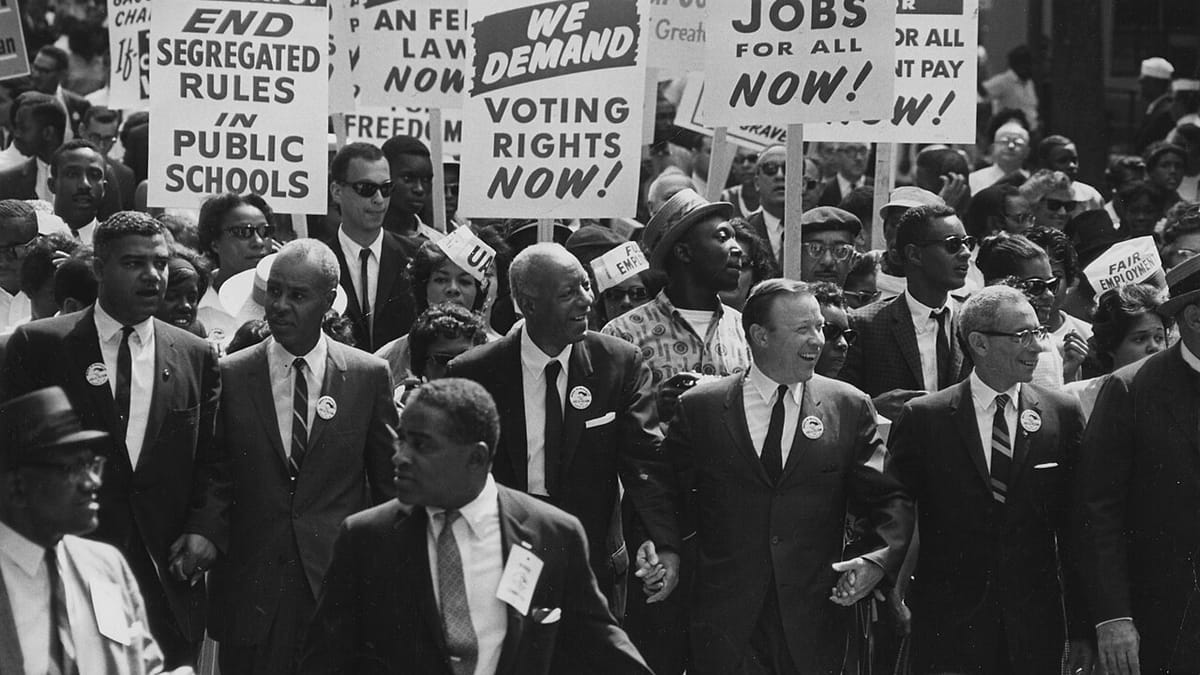
- 1963: Protests in Birmingham, Alabama, met with police dogs and fire hoses. In August, about 250,000 people joined the March on Washington, where King delivered his "I Have a Dream" speech.
- 1964: The Civil Rights Act banned discrimination in public places and employment on the basis of race, color, religion, sex or national origin.
- 1965: State troopers attacked marchers on the Edmund Pettus Bridge in Selma, Alabama, on "Bloody Sunday". Months later President Lyndon B. Johnson signed the Voting Rights Act.
- 1968: King was assassinated in Memphis. Days later, Congress passed the Fair Housing Act.
The women of the movement
Women were central organizers, even when men received most of the public attention. Ella Baker helped found SNCC; Fannie Lou Hamer, a sharecropper beaten for trying to register to vote, challenged the Democratic Party at its 1964 convention; Diane Nash led sit-ins and the Freedom Rides; Dorothy Height led the National Council of Negro Women; and Jo Ann Robinson organized the first leaflets of the Montgomery bus boycott.
Methods
Most leaders embraced nonviolent direct action, influenced by Christian teaching and Mahatma Gandhi's campaigns in India. Others, such as Malcolm X and later the Black Power movement, argued for self-defense and Black self-reliance.
Legacy
The movement ended legal segregation and transformed voting in the South, and it inspired movements for women's rights, disability rights, gay rights and the rights of other minorities in the United States and around the world. Debates continue over voting laws, policing and economic inequality; in Shelby County v. Holder (2013), the Supreme Court struck down the formula that had required some states to get federal approval before changing voting rules.
Frequently Asked Questions
When was the civil rights movement?
Its peak is usually dated from the Brown v. Board decision in 1954 to the Fair Housing Act of 1968, though the struggle began earlier and continued after.
What did the Civil Rights Act of 1964 do?
It outlawed discrimination based on race, color, religion, sex or national origin in public accommodations and employment.