The Russian Revolution of 1917 Explained
How war, hunger and a collapsing monarchy brought Lenin's Bolsheviks to power and created the Soviet Union.
In brief: The Russian Revolution was a series of upheavals in 1917 that ended the rule of the Romanov dynasty and brought the Bolshevik party, led by Vladimir Lenin, to power. It began with the February Revolution, which forced Tsar Nicholas II to abdicate, and continued with the October Revolution, in which the Bolsheviks seized power. A civil war followed, and in 1922 the Union of Soviet Socialist Republics was founded.
Russia before 1917
Russia was an autocracy ruled by the tsar, with a huge peasant population, a small but fast-growing industrial working class and deep inequality. A revolution in 1905, after defeat in a war with Japan, forced Nicholas II to create a parliament, the Duma, but he kept most of his power.
The war and the February Revolution
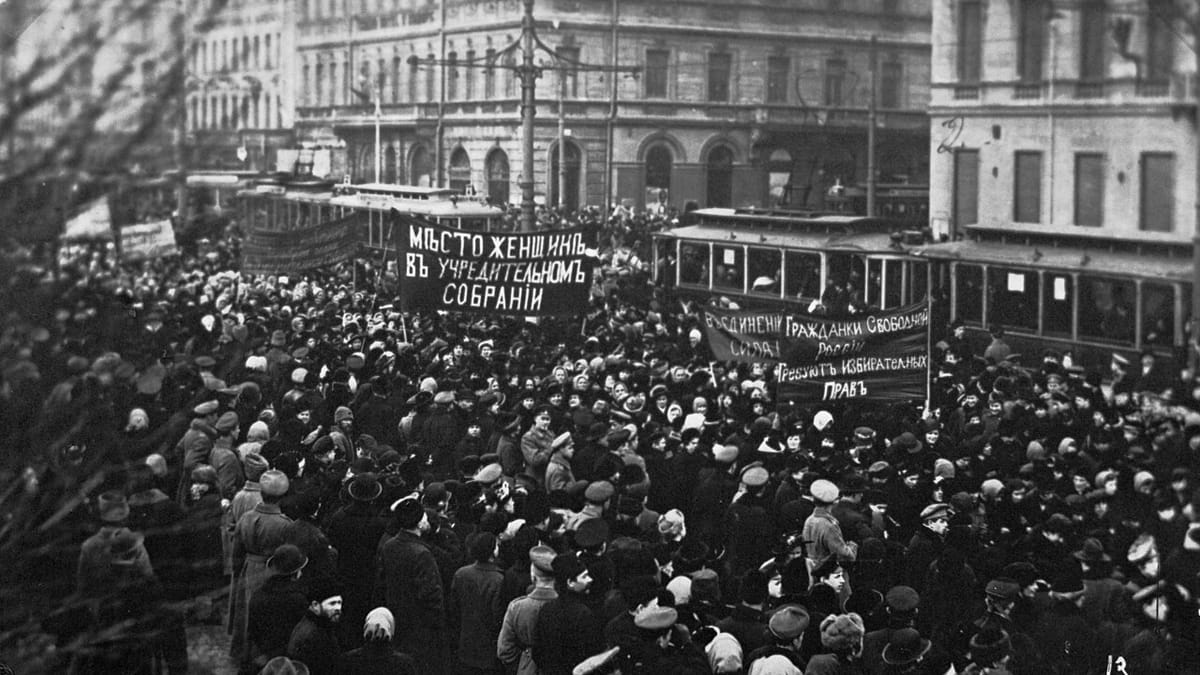
The First World War was disastrous for Russia. Millions of soldiers were killed, wounded or captured, and food and fuel shortages spread. In late February 1917 by the Julian calendar then used in Russia, or March by the modern calendar, strikes and bread protests in Petrograd, now Saint Petersburg, began on International Women's Day, when women textile workers walked out. Soldiers refused to fire on the crowds and joined them. Nicholas II abdicated in March, ending more than 300 years of Romanov rule.
Dual power
A Provisional Government of liberals and moderate socialists took over, but it shared authority with the Petrograd Soviet, a council of workers' and soldiers' deputies. The Provisional Government, later led by Alexander Kerensky, kept Russia in the war, which proved deeply unpopular. Lenin returned from exile in April and promised "peace, land and bread".
The October Revolution
On 25 October 1917 by the old calendar, 7 November by the modern one, Bolshevik forces led by Lenin and Leon Trotsky seized key points in Petrograd and the Winter Palace, the seat of the Provisional Government. A new government, the Council of People's Commissars, issued decrees on peace and on the redistribution of land.
Civil war and the Soviet state
The Bolsheviks dissolved the elected Constituent Assembly in January 1918, signed the Treaty of Brest-Litovsk with Germany in March 1918, and fought a brutal civil war from 1917 to 1922 against the anti-Bolshevik "Whites" and foreign interventions. Nicholas II and his family were executed in Yekaterinburg in July 1918. Millions died from fighting, terror, famine and disease. The USSR was established in December 1922.
Its impact on the world
The revolution inspired communist movements across the world and shaped the rest of the twentieth century, from the rise of Stalin to the Cold War. Soviet Russia was among the first states to give women the vote and legal equality on paper, and it legalised divorce and abortion in its early years, though many of these freedoms were later rolled back. Its promise of equality came with one-party rule, repression and, under Stalin, mass terror.
Frequently Asked Questions
Why are there two dates for the October Revolution?
Russia used the Julian calendar until 1918. The revolution took place on 25 October by that calendar, which was 7 November by the Gregorian calendar used today.
Who led the Bolsheviks?
Vladimir Lenin, with Leon Trotsky playing a key role in the seizure of power.