The Industrial Revolution Explained: How Machines Remade the World
Steam, factories and railways transformed how people worked and lived, beginning in Britain in the eighteenth century.
In brief: The Industrial Revolution was the shift from hand production to machine manufacturing that began in Britain around 1760 and spread to Europe, North America and eventually the world. Powered first by water and then by steam and coal, it created factories, railways and industrial cities, and led to the greatest rise in living standards and population in human history, as well as harsh working conditions and environmental damage.
Why Britain?
Historians point to several factors: plentiful coal and iron ore, a growing population, an agricultural revolution that produced more food with fewer workers, access to capital, a large colonial empire that supplied raw materials and markets, and a culture that rewarded invention and patents.
Key inventions
- Textiles: the spinning jenny of James Hargreaves (around 1764), Richard Arkwright's water frame (1769) and Samuel Crompton's spinning mule (1779) multiplied the output of cotton thread. Arkwright's mills are often seen as the first modern factories.
- Steam: James Watt's improvements to the steam engine, patented in 1769, made steam power efficient enough to drive factories, mines and later locomotives.
- Iron: using coke instead of charcoal, pioneered by Abraham Darby, made iron cheaper and more abundant.
- Railways: George and Robert Stephenson's locomotive Rocket won the Rainhill Trials in 1829, and the Liverpool and Manchester Railway opened in 1830 as the first intercity line to rely entirely on steam locomotives.
Life in the industrial city
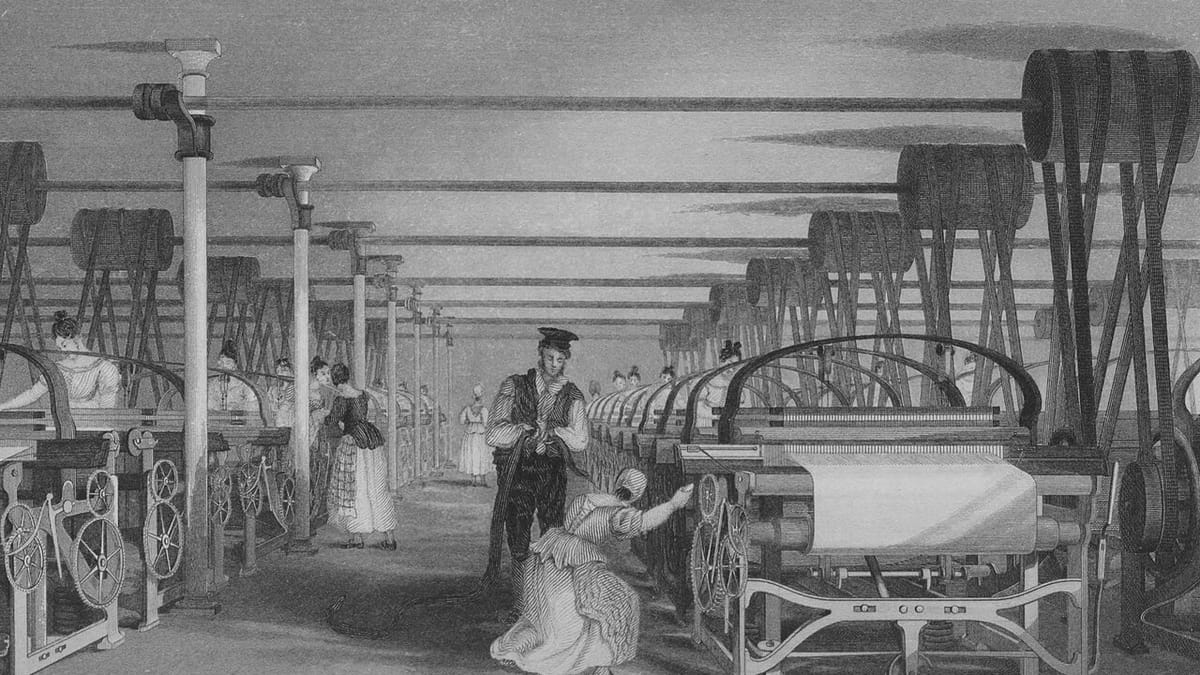
Millions moved from the countryside to towns such as Manchester, which grew rapidly. Workers, including women and young children, often laboured twelve hours or more a day in dangerous mills and mines, and crowded housing spread diseases such as cholera. Reform followed slowly: Britain's Factory Act of 1833 limited the hours of child workers and created factory inspectors, and trade unions eventually won legal recognition.
The connection to South Asia
Cheap machine-made British cotton cloth flooded the Indian market in the nineteenth century, contributing to the decline of traditional hand weaving in regions such as Bengal, while India supplied raw cotton. Many historians see this as part of how colonial rule reshaped the economy of the subcontinent.
The second industrial revolution
From the late nineteenth century, a second wave brought steel, electricity, chemicals, the telephone and the internal combustion engine, led by Germany and the United States as well as Britain.
Legacy
The Industrial Revolution created modern economic growth, the working and middle classes and new political movements, including socialism. Its reliance on coal also began the large-scale burning of fossil fuels that drives climate change today.
Frequently Asked Questions
When did the Industrial Revolution begin?
Historians usually date it to around 1760 in Britain, lasting until about 1840, with a second phase from the late nineteenth century.
What was the most important invention of the Industrial Revolution?
Many historians point to James Watt's improved steam engine, which powered factories, mines and railways.