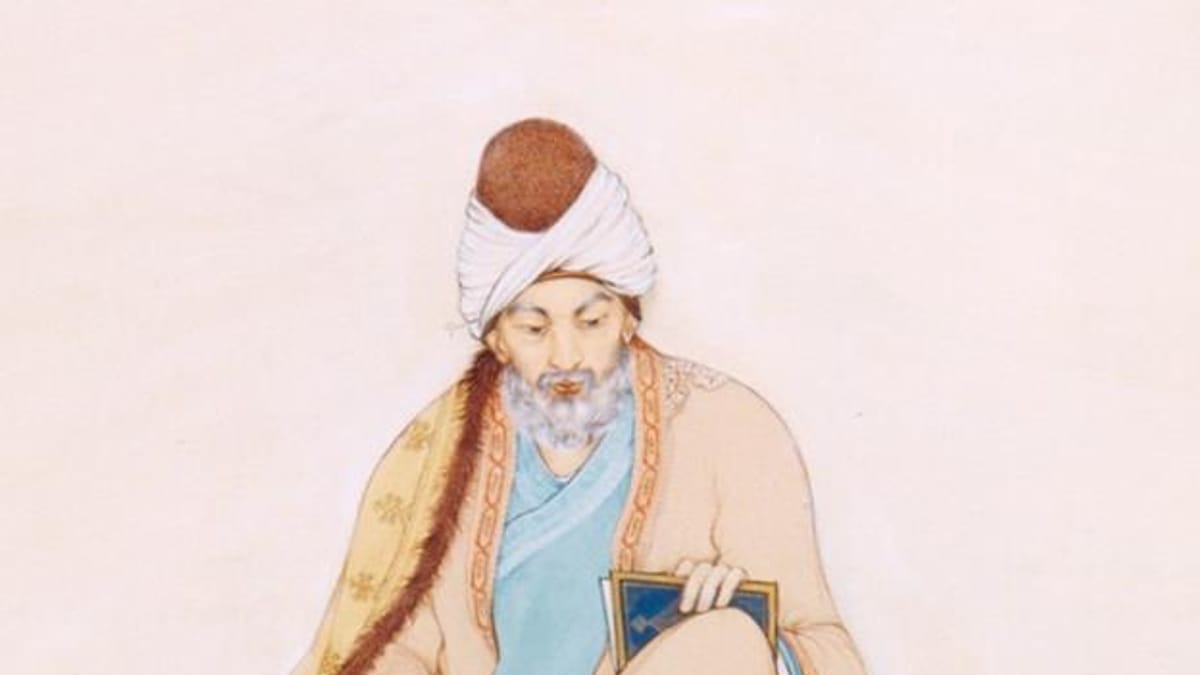
Bulleh Shah: The Sufi Poet of Punjab Who Questioned Everything
The eighteenth century mystic whose verses against hypocrisy and division are still sung across Pakistan and India.
In brief: Bulleh Shah (around 1680 to 1757) was a Punjabi Sufi poet and philosopher. Born Abdullah Shah, he wrote mostly in the poetic form known as the kafi, in simple Punjabi, attacking religious hypocrisy, caste pride and empty ritual, and celebrating divine love. His poems are sung by qawwals and folk and pop singers alike, and his shrine in Kasur, Pakistan, is one of the most visited in Punjab.
Life
Bulleh Shah was born around 1680, traditionally said to be in Uch, in present-day Bahawalpur district, into a family of Syeds, who claim descent from the Prophet Muhammad. His family later moved to the village of Pandoke near Kasur. He received an education in Arabic, Persian and Islamic studies.
His teacher
Against the wishes of his family, he became the disciple of Shah Inayat Qadiri, a Sufi master in Lahore who belonged to the Arain community, a caste of farmers and gardeners considered lower in status than the Syeds. His family's objection that a Syed should not follow an Arain appears in his poetry, where he declares that anyone who calls him a Syed will be punished in hell. Stories tell of a period when his teacher was displeased with him, and Bulleh Shah danced in the streets to win back his favour.
His poetry
His most famous kafis include "Bulla ki jaana main kaun", "Bulleh, who knows who I am", in which he says he is neither a believer in the mosque nor an unbeliever, neither pure nor impure, neither Moses nor Pharaoh. His poems mock those who read many books but do not know themselves, and those who perform prayers and pilgrimages while their hearts remain unchanged.
He lived during a violent era, with the decline of the Mughal Empire, conflicts with the Sikhs and invasions from Afghanistan, and his verses on tolerance and the unity of humanity spoke directly to those times.
Death and the shrine
Bulleh Shah died in Kasur in 1757. According to tradition, the local clergy refused to allow his burial in the town's graveyard because of his unorthodox views, so he was buried outside it. The town has since grown around his tomb, which hosts an annual urs festival with music and devotional singing.
Legacy
Bulleh Shah belongs to a line of great Punjabi Sufi poets that includes Baba Farid, Shah Hussain and Waris Shah. He is equally loved in Pakistani and Indian Punjab and by Muslims, Sikhs and Hindus. His poems have been performed by Abida Parveen and Nusrat Fateh Ali Khan and adapted by rock bands such as Junoon and singers such as Rabbi Shergill, whose 2005 song "Bulla Ki Jaana" became a hit across South Asia.
Frequently Asked Questions
Where is Bulleh Shah buried?
In Kasur, Punjab, Pakistan, where his shrine is a major site of pilgrimage.
What is a kafi?
A form of Sufi poetry, usually in Punjabi or Sindhi, sung to music and built around a repeated refrain.