Rumi: The Thirteenth-Century Mystic Who Still Speaks to the World
A scholar transformed by friendship, he wrote the Masnavi and inspired the whirling dervishes.
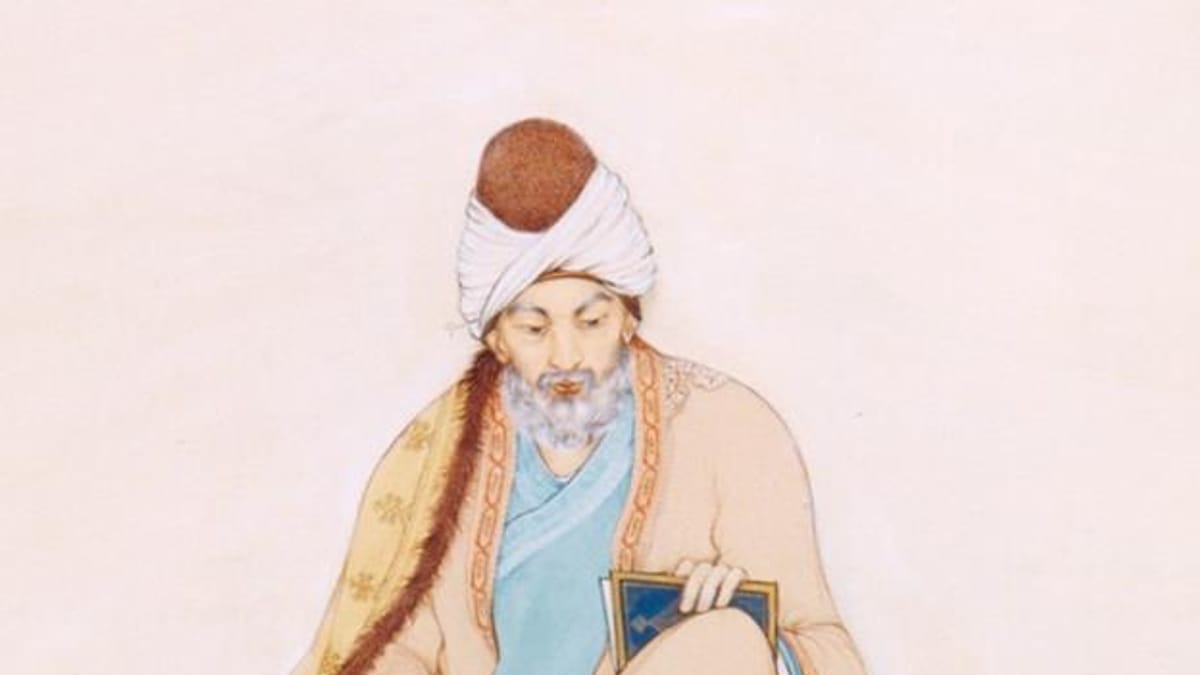
In brief: Jalaluddin Muhammad Rumi (1207 to 1273) was a Persian poet, Islamic scholar and Sufi mystic. His six-volume Masnavi and his collection of lyric poems, the Divan-e Shams, are masterpieces of Persian literature. The Mevlevi order of "whirling dervishes" was founded by his followers.
Early life
Rumi was born on 30 September 1207 in Balkh, in present-day Afghanistan, or possibly in Vakhsh in present-day Tajikistan. Fleeing the Mongol advance, his family travelled across the Muslim world and settled in Konya, in Anatolia, then ruled by the Seljuk sultans. Like his father, he became a respected teacher of Islamic law and theology.
Shams of Tabriz
In 1244 he met Shams of Tabriz, a wandering dervish. Their intense spiritual friendship transformed Rumi, who turned to music, dance and poetry. Shams disappeared around 1248, possibly murdered by jealous disciples, and Rumi's grief poured into thousands of verses addressed to him.
The Masnavi
Over his last years, Rumi dictated the Masnavi, around 25,000 rhyming couplets of stories, parables and reflections on the soul's longing for God. It opens with the reed flute lamenting its separation from the reed bed, an image of the human soul separated from its source.
Legacy
Rumi died in Konya on 17 December 1273, a night his followers call his "wedding night" with God. His tomb is a place of pilgrimage. Popular English versions have made him one of the best-selling poets in the United States, though scholars note many remove his Islamic context.
Frequently Asked Questions
Who was Shams of Tabriz?
A wandering dervish whose friendship with Rumi from 1244 transformed him from a scholar into a mystical poet.