Susan B. Anthony: The Woman Who Was Arrested for Voting
Abolitionist, organizer and the most famous campaigner for American women's right to vote.
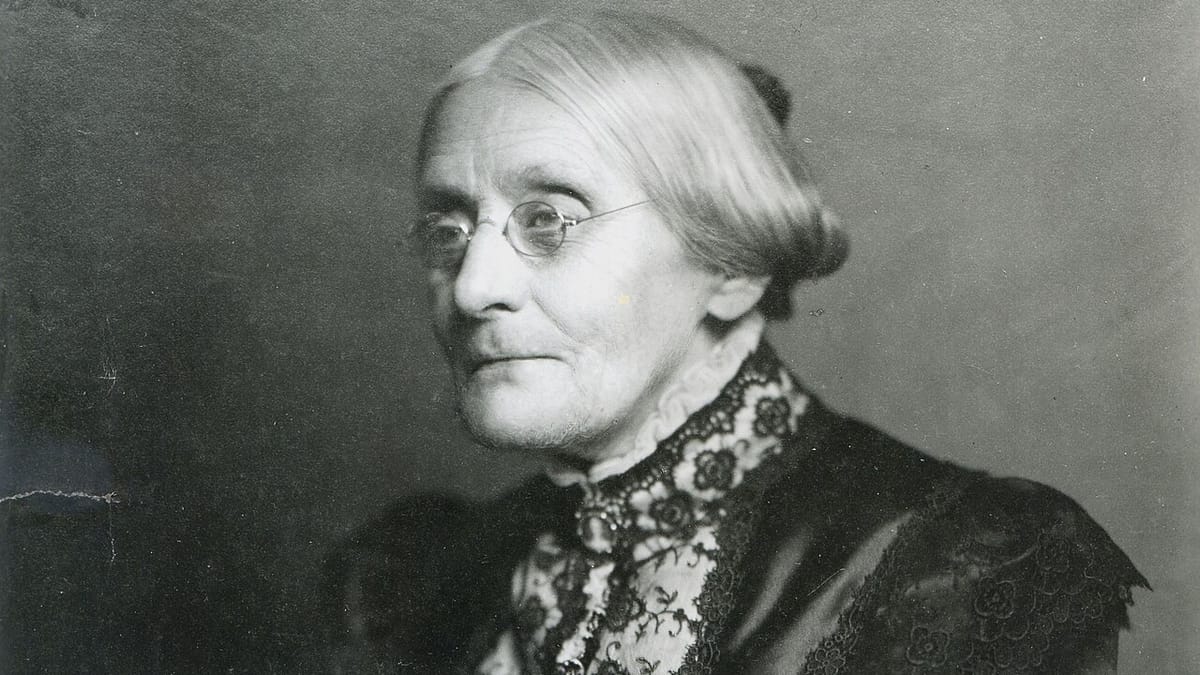
In brief: Susan B. Anthony (1820 to 1906) was an American social reformer who campaigned against slavery and for women's rights, above all the right to vote. With Elizabeth Cady Stanton she founded the National Woman Suffrage Association in 1869. In 1872 she was arrested for voting in a presidential election. She died 14 years before the 19th Amendment, sometimes called the Susan B. Anthony Amendment, was ratified.
Early life
Susan Brownell Anthony was born on February 15, 1820, in Adams, Massachusetts, into a Quaker family that believed in equality before God and opposed slavery. She worked as a teacher, and was angered to learn that she was paid a fraction of what male teachers earned. Her family moved to near Rochester, New York, where their farm became a meeting place for abolitionists, including Frederick Douglass.
Partnership with Stanton
In 1851 Anthony met Elizabeth Cady Stanton, beginning a partnership that lasted more than 50 years. Stanton, a mother of seven, was the more gifted writer; Anthony, who never married, was the tireless organizer and speaker who travelled the country. As Stanton put it, "I forged the thunderbolts, she fired them."
Abolition and the 15th Amendment
Anthony worked for the American Anti-Slavery Society in the 1850s and, during the Civil War, helped collect hundreds of thousands of signatures for a petition supporting the 13th Amendment to abolish slavery. After the war, she and Stanton opposed the 15th Amendment because it protected voting rights for Black men but not for women, a stance that split the women's movement and led to some statements that historians criticize as racist.
Arrested for voting
In November 1872 Anthony and about 14 other women voted in the presidential election in Rochester, arguing that the 14th Amendment made them citizens with the right to vote. She was arrested, tried in 1873 and, without being allowed to testify, found guilty by order of the judge, who fined her 100 dollars. She declared that she would never pay "a dollar of your unjust penalty", and she never did.
Later years
Anthony continued to campaign into her eighties, helped unite rival suffrage groups into the National American Woman Suffrage Association in 1890 and served as its president. She also helped compile the multi-volume History of Woman Suffrage. At her last public appearance, shortly before her death on March 13, 1906, she declared, "Failure is impossible."
Legacy
In 1979 she became the first real woman depicted on a circulating US coin, the Susan B. Anthony dollar. On election days, voters in Rochester visit her grave in Mount Hope Cemetery and place their "I Voted" stickers on her headstone.
Frequently Asked Questions
Why was Susan B. Anthony arrested?
For voting in the 1872 presidential election in Rochester, New York, when women did not have the legal right to vote.
Did Susan B. Anthony live to see women vote nationally?
No. She died in 1906, 14 years before the 19th Amendment was ratified in 1920.