Ruth Bader Ginsburg: The Lawyer Who Made Equality a Constitutional Principle
Before she was a Supreme Court justice and a pop culture icon, she changed the law on sex discrimination case by case.
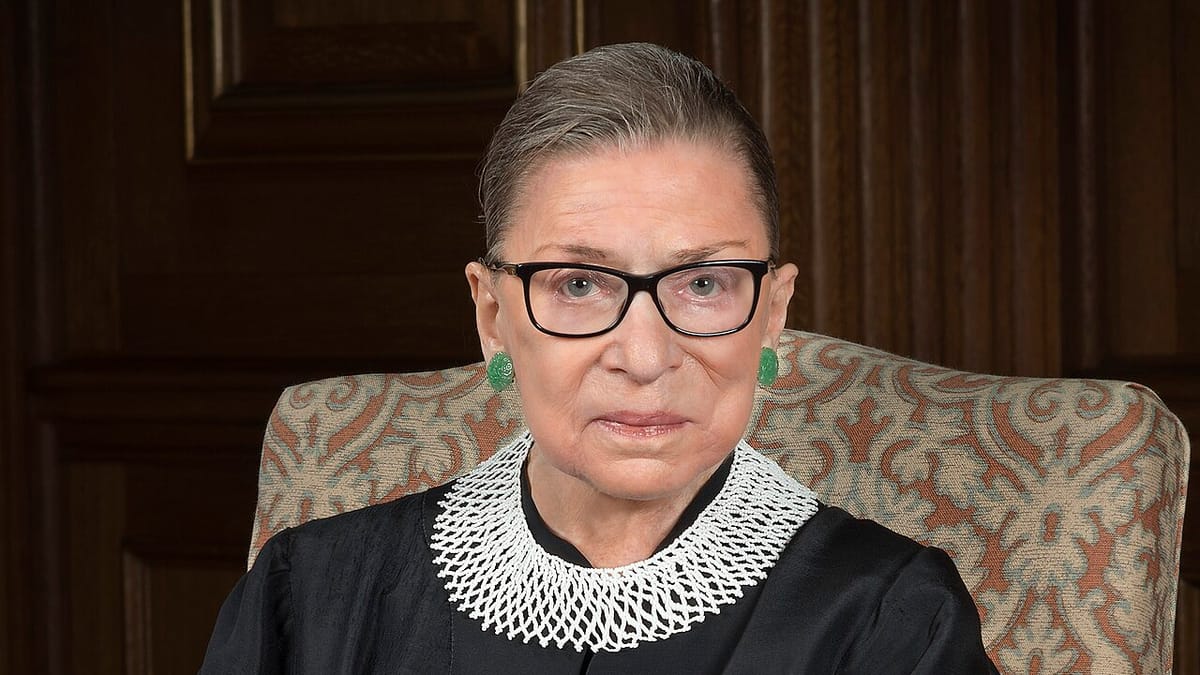
In brief: Ruth Bader Ginsburg (1933 to 2020) was an American lawyer and judge who served as an associate justice of the US Supreme Court from 1993 until her death. In the 1970s, as director of the ACLU's Women's Rights Project, she won a series of cases that established that the Constitution's guarantee of equal protection applies to discrimination based on sex. Late in life she became a cultural icon known as "the Notorious RBG".
Early life and education
Joan Ruth Bader was born in Brooklyn, New York, on March 15, 1933. Her mother, who died the day before Ruth's high school graduation, encouraged her love of learning. At Cornell University she met Martin Ginsburg, whom she married in 1954. She was one of about nine women in a class of more than 500 at Harvard Law School, where the dean asked the women how they could justify taking a place from a man. When her husband took a job in New York, she transferred to Columbia Law School and graduated tied for first in her class in 1959.
Shut out, then breaking through
Despite her record, no New York law firm would hire her, and Supreme Court Justice Felix Frankfurter declined to consider her as a clerk because she was a woman. She clerked for a federal district judge, studied civil procedure in Sweden, and became one of the first women law professors in the country, at Rutgers and then Columbia, where she was the first woman to earn tenure.
The equality cases
In 1971 she wrote the main brief in Reed v. Reed, in which the Supreme Court for the first time struck down a law because it discriminated against women. In 1972 she co-founded the ACLU Women's Rights Project. She argued six cases before the Supreme Court and won five. She often chose male plaintiffs to show that sex stereotypes harmed everyone, as in Weinberger v. Wiesenfeld (1975), which concerned a widower denied Social Security benefits available to widows.
Judge and justice
President Jimmy Carter appointed her to the US Court of Appeals for the District of Columbia Circuit in 1980. President Bill Clinton nominated her to the Supreme Court in 1993, and the Senate confirmed her by 96 votes to 3. She was the second woman to serve on the court, after Sandra Day O'Connor. Her majority opinion in United States v. Virginia (1996) required the Virginia Military Institute to admit women.
The great dissenter
As the court moved to the right, she became known for her dissents. Her dissent in Ledbetter v. Goodyear (2007), on pay discrimination, called on Congress to act, and in 2009 the Lilly Ledbetter Fair Pay Act became the first bill signed by President Barack Obama.
Death and legacy
Ginsburg survived several bouts of cancer and continued to work. She died on September 18, 2020, at age 87, and became the first woman to lie in state at the US Capitol. Her work helped make sex discrimination a matter of constitutional law, and she remains an inspiration to generations of women in law.
Frequently Asked Questions
When did Ruth Bader Ginsburg join the Supreme Court?
In 1993, after being nominated by President Bill Clinton. She served until her death in 2020.
What was Ruth Bader Ginsburg known for before the Supreme Court?
Leading the ACLU Women's Rights Project and winning landmark sex discrimination cases in the 1970s.