Noor Inayat Khan: The Sufi Princess Who Became a Wartime Secret Agent
A children's author of Indian descent, she worked as a radio operator in occupied Paris and refused to break under interrogation.
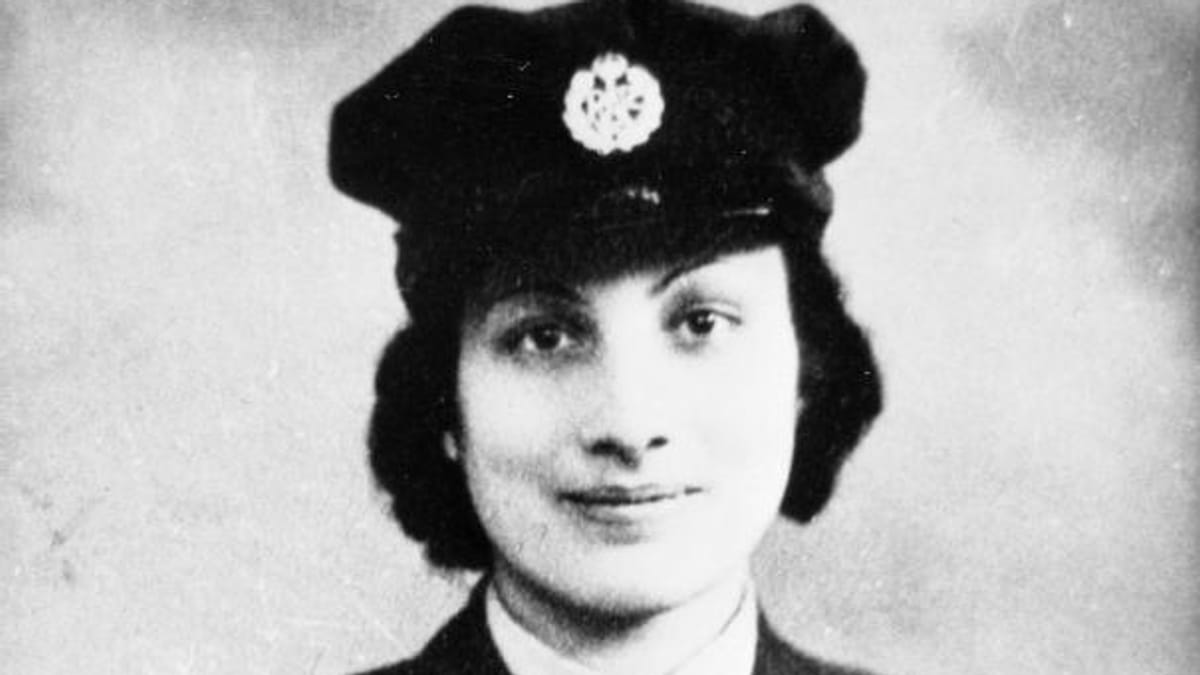
In brief: Noor Inayat Khan (1914 to 1944) was a British agent of Indian descent who served with the Special Operations Executive (SOE) during the Second World War. In 1943 she became the first female wireless operator sent into Nazi-occupied France. Betrayed and captured, she was executed at Dachau concentration camp in September 1944. She was posthumously awarded the George Cross, Britain's highest civilian award for gallantry.
Early life
Noor-un-Nisa Inayat Khan was born in Moscow on 1 January 1914. Her father, Inayat Khan, was an Indian musician and Sufi teacher who brought Sufism to the West, and he was a descendant of Tipu Sultan, the eighteenth century ruler of Mysore. Her mother, Pirani Ameena Begum, was American. The family moved to London and then to Paris, where Noor grew up. She studied child psychology at the Sorbonne and music, and wrote children's stories, publishing Twenty Jataka Tales, based on Buddhist stories, in 1939.
Joining the war
When Germany invaded France in 1940, the family escaped to England. Noor, influenced by her father's teaching of nonviolence, nonetheless decided to fight fascism. She joined the Women's Auxiliary Air Force and trained as a wireless operator. Her skills brought her to the attention of the SOE, the secret organisation sent to support resistance movements in occupied Europe.
In occupied Paris
In June 1943 she was flown into France under the code name "Madeleine". Within weeks, the Gestapo arrested most members of her resistance network. Offered the chance to return to England, she refused, and for months she was one of the few radio operators still sending messages from Paris, moving constantly to avoid detection.
Capture and death
In October 1943 she was betrayed and arrested. She attempted to escape twice and was classified as highly dangerous. She was sent to Germany, held in chains in solitary confinement and, according to accounts, refused to give her captors any information. On 13 September 1944 she was taken to Dachau and executed with three other female SOE agents. Her last word is reported to have been "Liberté".
Honours
Noor Inayat Khan was posthumously awarded the George Cross in 1949 and the French Croix de Guerre with gold star. In 2012 a bronze bust of her was unveiled in Gordon Square in London, near the house where she once lived, the first memorial in Britain to a woman of South Asian descent. In 2020 she became the first woman of Indian origin to be honoured with an English Heritage blue plaque.
Frequently Asked Questions
Why is Noor Inayat Khan famous?
She was a British secret agent who worked as a radio operator in Nazi-occupied Paris and was executed at Dachau in 1944 after refusing to give information.
What award did Noor Inayat Khan receive?
The George Cross, awarded posthumously in 1949, and the French Croix de Guerre.