Marie Curie: The Scientist Who Won Two Nobel Prizes and Changed Physics and Medicine
She discovered two elements, created the theory of radioactivity and remains the only person to win Nobel Prizes in two different sciences.
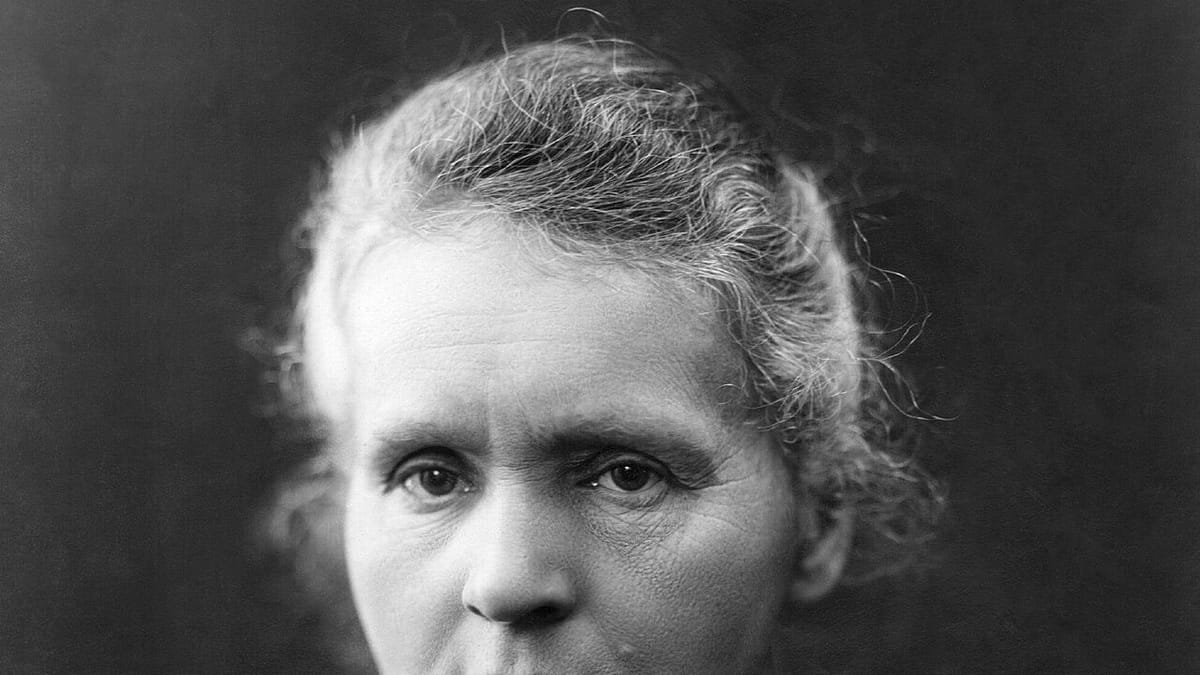
In brief: Marie Curie (1867 to 1934) was a Polish-born French physicist and chemist. She coined the term "radioactivity", discovered the elements polonium and radium with her husband Pierre, and won the Nobel Prize in Physics in 1903 and in Chemistry in 1911. She was the first woman to win a Nobel Prize and remains the only person to have won in two different sciences.
Childhood in occupied Poland
Maria Skłodowska was born in Warsaw on 7 November 1867, the youngest of five children of two teachers. Poland was then partitioned, and Warsaw was ruled by the Russian Empire, which restricted Polish education. Women could not attend university. Maria studied in secret at the clandestine "Flying University" and worked as a governess for years to help pay for her sister Bronisława's medical studies in Paris, on the understanding that Bronisława would later help her in turn.
Paris and the Sorbonne
In 1891 she moved to Paris and enrolled at the Sorbonne, where she lived on very little money. She earned a degree in physics in 1893 and in mathematics in 1894. That year she met Pierre Curie, a physicist working on magnetism and crystals. They married in 1895 and became one of the most productive partnerships in the history of science.
Discovering radioactivity
Inspired by Henri Becquerel's discovery that uranium emitted mysterious rays, Marie chose the phenomenon as the subject of her doctoral research. Using an electrometer developed by Pierre and his brother, she showed that the rays depended only on the amount of uranium present, suggesting the radiation came from the atom itself. This insight, that radiation is an atomic property, laid foundations for modern physics.
Finding that the mineral pitchblende was more active than its uranium content could explain, the Curies searched for unknown elements. In 1898 they announced two: polonium, named after Marie's homeland, and radium. Isolating radium took years of exhausting work processing tonnes of ore in a poorly equipped shed.
Two Nobel Prizes
In 1903 Marie and Pierre Curie shared the Nobel Prize in Physics with Henri Becquerel for their research on radiation. Marie was the first woman to receive a Nobel Prize. The same year she became the first woman in France to receive a doctorate in physics.
In 1906 Pierre was killed when he was struck by a horse-drawn wagon in a Paris street. Marie took over his teaching post, becoming the first woman professor at the Sorbonne. In 1911 she won the Nobel Prize in Chemistry, alone, for the discovery of radium and polonium and the isolation of radium.
The second prize came during a hostile press campaign in France over her private life, and she faced prejudice as a woman and a foreigner, including a narrow defeat in her bid to join the French Academy of Sciences in 1911.
War work: the "little Curies"
When the First World War began in 1914, Curie developed mobile X-ray units so that surgeons near the front could locate bullets and shrapnel. These vehicles became known as "petites Curies". She learned to drive, trained women as radiology operators, and travelled to the front lines with her daughter Irène. Historians estimate that more than a million wounded soldiers were examined with the X-ray services she helped create.
Later life and death
After the war she led the Radium Institute in Paris, which became a world centre for research into radioactivity and its use in cancer treatment. Years of exposure to radiation, whose dangers were not then understood, damaged her health. She died of aplastic anaemia on 4 July 1934 in a sanatorium at Passy, in the French Alps. Her notebooks remain radioactive today.
In 1935 her daughter Irène Joliot-Curie and son-in-law Frédéric Joliot won the Nobel Prize in Chemistry for discovering artificial radioactivity. In 1995 Marie and Pierre Curie's remains were moved to the Panthéon in Paris; she was the first woman to be honoured there for her own achievements.
Why she still matters
Curie's work underpins radiotherapy, medical imaging and nuclear physics. Just as importantly, her life showed generations of women that science was theirs too, at a time when universities in her own country would not admit her.
Timeline
- 7 November 1867: Born in Warsaw
- 1891: Enrols at the Sorbonne in Paris
- 1895: Marries Pierre Curie
- 1898: Announces the discovery of polonium and radium
- 1903: Nobel Prize in Physics, shared with Pierre Curie and Henri Becquerel
- 1906: Pierre dies; Marie becomes the Sorbonne's first woman professor
- 1911: Nobel Prize in Chemistry
- 1914 to 1918: Organises mobile X-ray units in the First World War
- 4 July 1934: Dies at Passy, France
- 1995: Interred in the Panthéon
Frequently Asked Questions
What did Marie Curie discover?
With Pierre Curie she discovered the elements polonium and radium in 1898. She also showed that radioactivity is a property of atoms, and coined the term radioactivity.
Why is Marie Curie famous for two Nobel Prizes?
She won the Nobel Prize in Physics in 1903 and in Chemistry in 1911. She was the first woman to win a Nobel Prize and is still the only person to win in two different sciences.
How did Marie Curie die?
She died of aplastic anaemia, linked to long exposure to radiation, on 4 July 1934.
Sources and References
- Marie Curie: Biographical, Nobel Prize Outreach
- Marie Curie: Facts, Nobel Prize in Chemistry 1911, Nobel Prize Outreach
- Marie Curie, Wikipedia (further reading)