What Is the G20? The Group of Twenty Explained
The forum where the world's largest economies try to coordinate on finance, trade and crises.
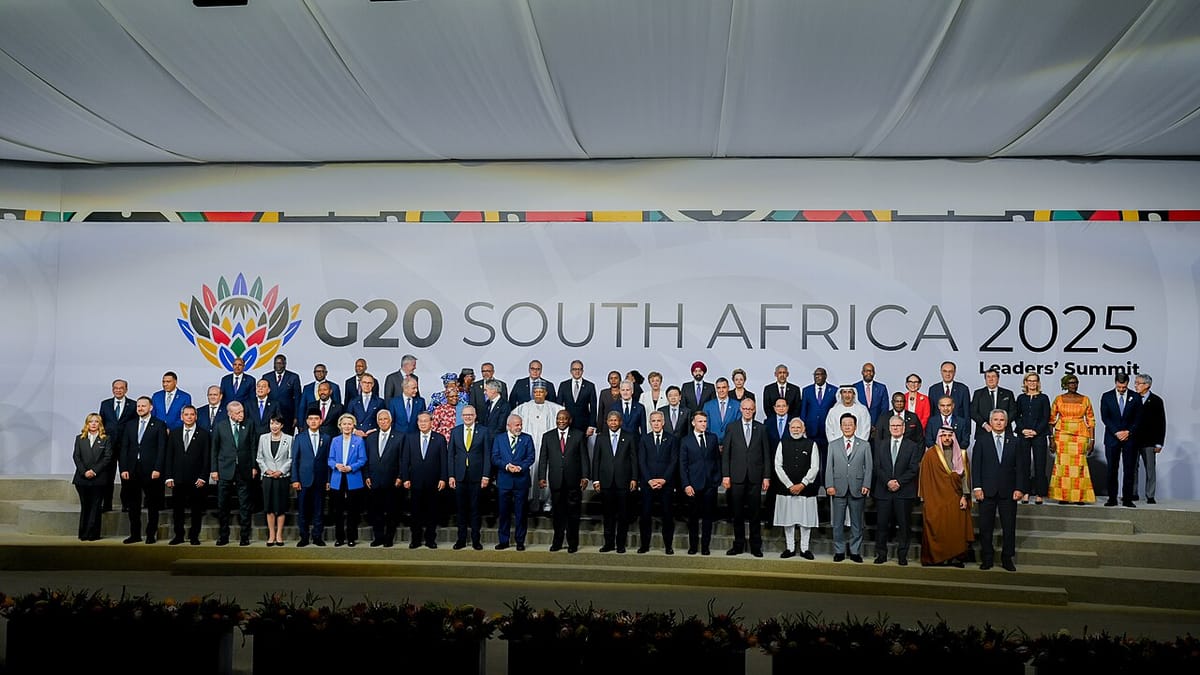
In brief: The Group of Twenty (G20) is a forum of 19 countries plus the European Union and the African Union. Its members account for around 85 percent of global economic output, about 75 percent of world trade and roughly two-thirds of the world's population. It was created in 1999 for finance ministers and became a leaders' summit in 2008 during the global financial crisis.
Members
The country members are Argentina, Australia, Brazil, Canada, China, France, Germany, India, Indonesia, Italy, Japan, Mexico, Russia, Saudi Arabia, South Africa, South Korea, Turkey, the United Kingdom and the United States. The European Union is a member, and the African Union joined as a permanent member at the New Delhi summit in 2023.
How it began
After the Asian financial crisis of 1997 and 1998, the G7 group of wealthy democracies recognised that major emerging economies needed a seat at the table. The G20 was founded in 1999 as a meeting of finance ministers and central bank governors. When the global financial crisis struck in 2008, US President George W. Bush hosted the first summit of G20 leaders in Washington. The 2009 London and Pittsburgh summits agreed large stimulus measures and declared the G20 the "premier forum" for international economic cooperation.
How it works
The G20 has no permanent secretariat. The presidency rotates each year, and the host sets the agenda and organises meetings of ministers and officials throughout the year, ending with the leaders' summit. Decisions are not legally binding; their force comes from political commitment.
What it has achieved
- Coordinated stimulus and stronger financial regulation after 2008, including the creation of the Financial Stability Board.
- The Debt Service Suspension Initiative during the Covid-19 pandemic, which paused debt payments for the poorest countries.
- Support for a global minimum corporate tax, agreed through the OECD in 2021.
Criticism
Critics say the G20 excludes most of the world's countries and that its statements are often vague. Divisions over the war in Ukraine and other conflicts have made joint declarations harder to agree. Supporters reply that it is the only forum where the major developed and developing economies meet as equals.
Pakistan and the G20
Pakistan is not a member. It has benefited from G20 debt relief programmes and, like other developing countries, is affected by G20 decisions on trade, finance and climate.
Frequently Asked Questions
How many members does the G20 have?
Nineteen countries plus the European Union and the African Union.
When did G20 leaders first meet?
In November 2008 in Washington, during the global financial crisis.