Alexander Fleming and the Accidental Discovery of Penicillin
A mouldy dish in a London laboratory began the age of antibiotics.
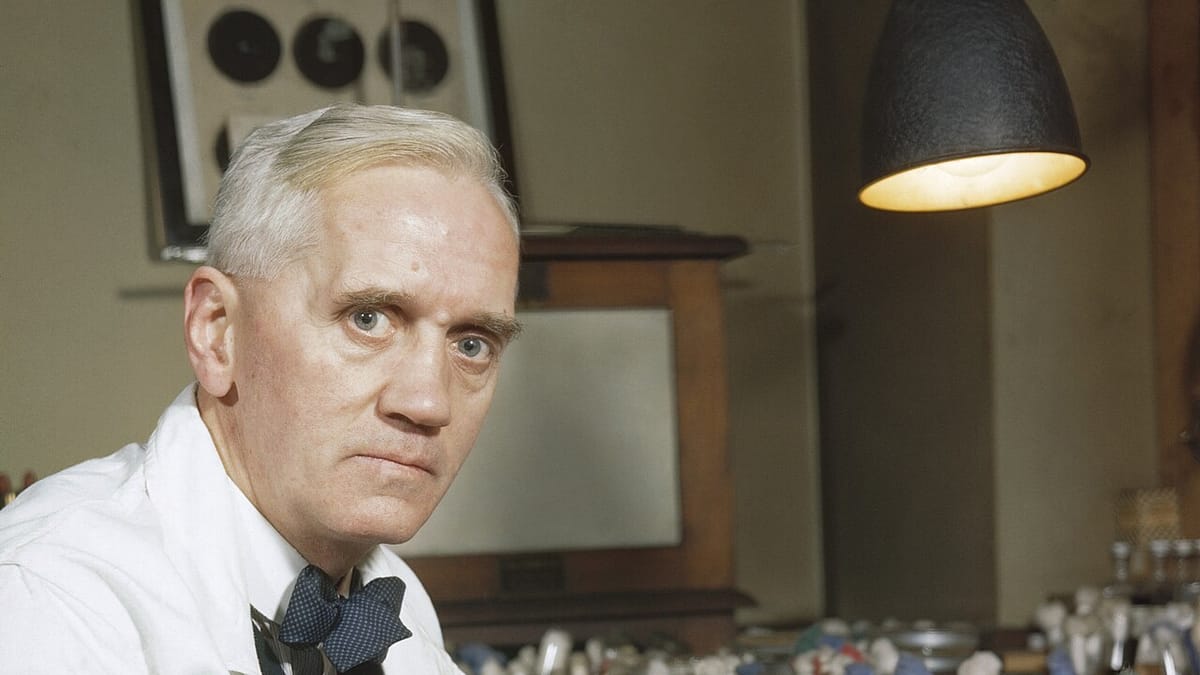
In brief: In 1928 the Scottish bacteriologist Alexander Fleming (1881 to 1955) noticed that a mould contaminating a culture dish had killed the surrounding bacteria. He named the substance penicillin. A decade later Howard Florey, Ernst Chain and their Oxford team turned it into a medicine. The three shared the 1945 Nobel Prize in Physiology or Medicine.
The discovery
Fleming was working at St Mary's Hospital in London. Returning from holiday in September 1928, he found that a dish of Staphylococcus bacteria had been contaminated by a Penicillium mould, and that the bacteria around the mould had been destroyed. He grew the mould and showed that its "juice" killed many disease-causing bacteria, but found it hard to purify and produce in useful quantities.
From mould to medicine
From 1939, Howard Florey and Ernst Chain at the University of Oxford, with colleagues including Norman Heatley, purified penicillin, tested it in mice and then in patients. With Britain at war, production moved largely to the United States, where companies scaled it up. By the D-Day landings in 1944, penicillin was available to treat Allied soldiers.
A warning
In his Nobel lecture in 1945, Fleming warned that misuse of penicillin could make bacteria resistant to it. Antibiotic resistance is now considered by the World Health Organization to be one of the most serious threats to global health.
Frequently Asked Questions
Who discovered penicillin?
Alexander Fleming in 1928. Howard Florey and Ernst Chain later developed it into a usable drug, and all three shared the 1945 Nobel Prize.
What is antibiotic resistance?
When bacteria evolve so that antibiotics no longer kill them, often because antibiotics are overused or misused.