Albert Einstein: The Physicist Who Reimagined Space and Time
From a patent office clerk to the most famous scientist of the twentieth century.
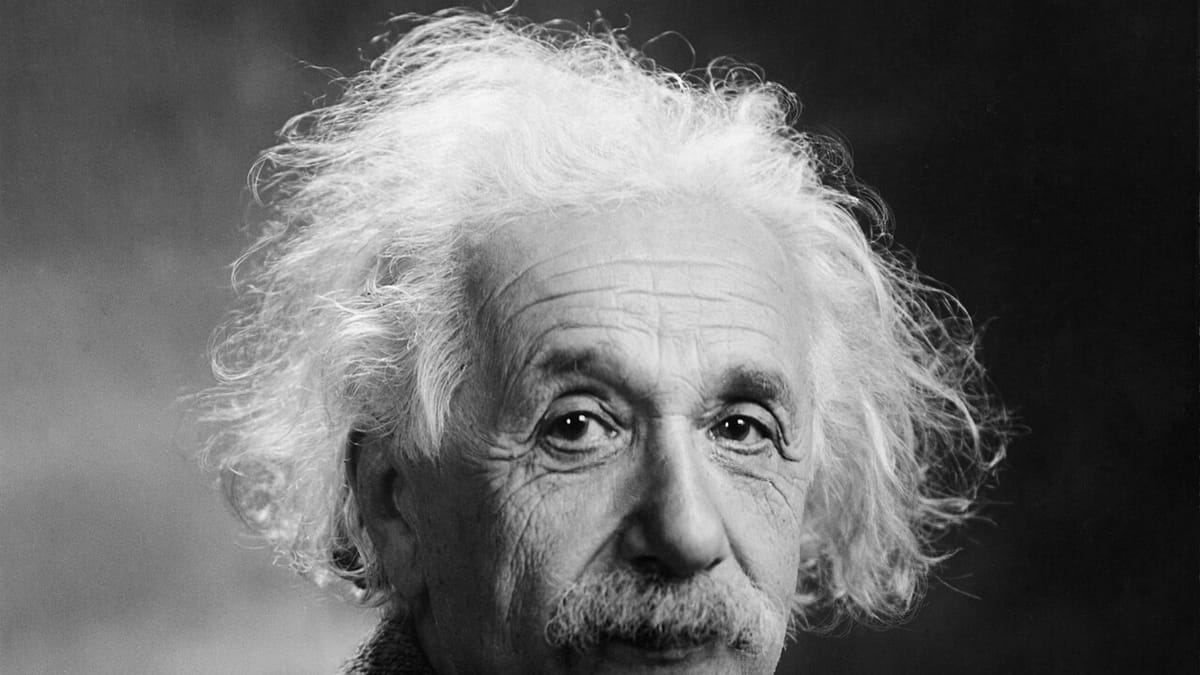
In brief: Albert Einstein (1879 to 1955) was a German-born theoretical physicist who developed the theory of relativity, one of the two pillars of modern physics. He received the 1921 Nobel Prize in Physics for his explanation of the photoelectric effect, which helped found quantum theory.
Early life
Einstein was born on 14 March 1879 in Ulm, Germany. He studied at the Swiss Federal Polytechnic in Zurich and, unable to find an academic post, worked as a technical examiner at the Swiss patent office in Bern.
The miracle year
In 1905, while at the patent office, he published four papers that transformed physics: on the photoelectric effect (proposing that light comes in quanta), on Brownian motion (providing evidence that atoms exist), on special relativity (showing that measurements of space and time depend on the observer's motion), and on the equivalence of mass and energy, expressed as E = mc².
General relativity
In 1915 he completed the general theory of relativity, which describes gravity as the curvature of space and time by mass and energy. In 1919 observations of a solar eclipse led by Arthur Eddington showed starlight bending around the Sun as he predicted, making Einstein world famous.
Exile and conscience
Einstein was Jewish. When the Nazis came to power in 1933 he settled in the United States at the Institute for Advanced Study in Princeton. In 1939 he signed a letter to President Franklin Roosevelt warning that Germany might develop an atomic bomb, which contributed to the Manhattan Project, though he did not work on it. After the war he campaigned for nuclear disarmament and civil rights. He died in Princeton on 18 April 1955.
Frequently Asked Questions
Did Einstein win the Nobel Prize for relativity?
No. He received the 1921 Nobel Prize in Physics for his explanation of the photoelectric effect.
What does E = mc2 mean?
It states that mass and energy are equivalent: energy equals mass multiplied by the speed of light squared.