The Korean War Explained: The Conflict That Never Officially Ended
Why a war fought from 1950 to 1953 still divides the Korean peninsula along a heavily armed border.
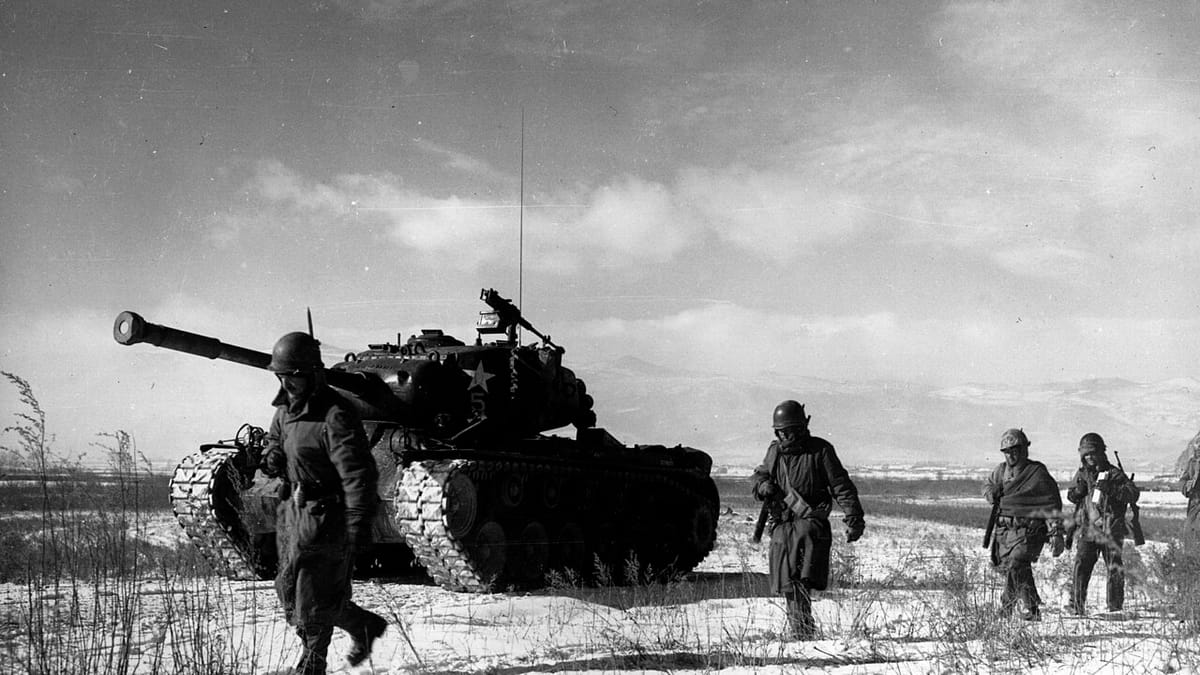
In brief: The Korean War was fought from 25 June 1950 to 27 July 1953 between North Korea, supported by China and the Soviet Union, and South Korea, supported by a United Nations force led by the United States. It began when North Korea invaded the South and ended with an armistice that left the peninsula divided close to where the war started. No peace treaty has ever been signed.
A divided peninsula
Korea was ruled by Japan from 1910 to 1945. After Japan's defeat in the Second World War, the peninsula was divided at the 38th parallel, with Soviet forces in the north and American forces in the south. In 1948 two rival states were created: the Republic of Korea in the south under Syngman Rhee, and the Democratic People's Republic of Korea in the north under Kim Il Sung. Each claimed to be the legitimate government of all Korea.
The invasion and the UN response
On 25 June 1950 North Korean forces crossed the 38th parallel with Soviet approval and quickly captured Seoul. The UN Security Council, which the Soviet Union was boycotting at the time over the question of China's seat, called on members to help South Korea. Sixteen countries sent combat troops, with the United States providing most of them.
The war's swings
- Summer 1950: UN and South Korean forces were pushed back to a small area around the port of Pusan.
- September 1950: General Douglas MacArthur's amphibious landing at Inchon cut North Korean supply lines, and UN forces advanced deep into the North toward the Chinese border.
- October to November 1950: China entered the war with hundreds of thousands of troops, pushing UN forces back south of Seoul.
- 1951 to 1953: the front stabilised near the 38th parallel, and the war became a costly stalemate while armistice talks dragged on, partly over the repatriation of prisoners of war.
The armistice
The armistice signed at Panmunjom on 27 July 1953 created the Korean Demilitarized Zone, a buffer about 4 kilometres wide that still separates the two Koreas. Because only an armistice was signed, the two Koreas technically remain at war.
The human cost
Estimates of the dead vary, but the war is thought to have killed around three million people, a majority of them civilians. Millions of families were separated by the new border, and many never saw their relatives again.
Legacy
The war hardened the Cold War in Asia, led to a permanent US military presence in South Korea and shaped North Korea's isolation and militarisation. South Korea went on to become a democracy and one of the world's leading economies, while North Korea developed nuclear weapons.
Frequently Asked Questions
Is the Korean War over?
Fighting ended with an armistice on 27 July 1953, but no peace treaty was signed, so technically the war has not formally ended.
Why did the Soviet Union not veto the UN resolution on Korea?
It was boycotting the Security Council at the time in protest at the Republic of China, not the People's Republic, holding China's seat.