The 19th Amendment: How American Women Won the Right to Vote
A 72-year campaign that ended with a single vote in Tennessee in August 1920, and the women it still left out.
In brief: The 19th Amendment to the US Constitution states that the right to vote "shall not be denied or abridged by the United States or by any State on account of sex." Congress passed it on June 4, 1919, and Tennessee became the 36th and decisive state to ratify it on August 18, 1920. It was certified on August 26, 1920, now marked as Women's Equality Day.
The long campaign
The organized movement for women's suffrage in the United States is usually dated to the Seneca Falls Convention of 1848, where Elizabeth Cady Stanton's Declaration of Sentiments demanded the vote. Many early suffragists were also abolitionists. After the Civil War, the 15th Amendment (1870) prohibited denying the vote on the basis of race but said nothing about sex, splitting the movement. Susan B. Anthony and Stanton formed the National Woman Suffrage Association in 1869 to seek a federal amendment, while Lucy Stone's American Woman Suffrage Association worked state by state. They merged in 1890.
The West leads
Wyoming Territory gave women the vote in 1869, and when it became a state in 1890 it was the first to have full women's suffrage. Colorado, Utah and Idaho followed in the 1890s, and by 1918 women had won full voting rights in 15 states, most of them in the West.
The final push
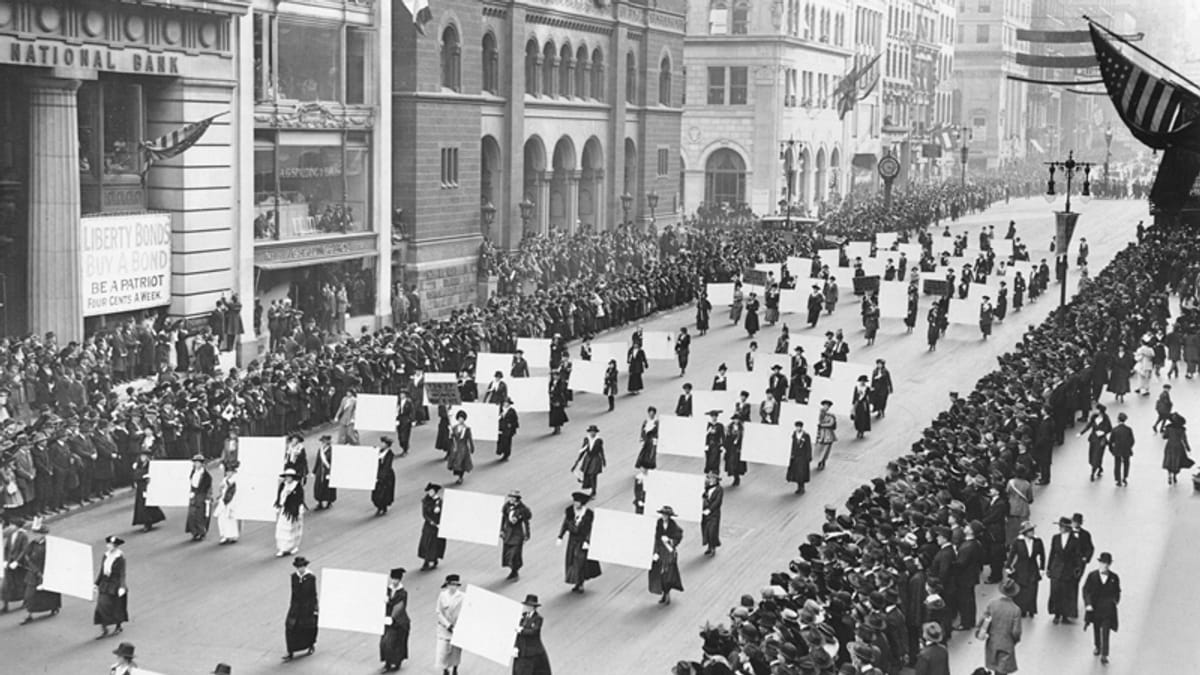
In the 1910s a new generation took the cause to Washington. Alice Paul organized a huge parade on the eve of President Woodrow Wilson's inauguration in 1913, and her National Woman's Party picketed the White House, the first group to do so. Many "Silent Sentinels" were arrested and force-fed during hunger strikes in prison. At the same time, Carrie Chapman Catt's National American Woman Suffrage Association pursued a disciplined state-by-state and congressional strategy. Women's work during the First World War strengthened their case, and Wilson endorsed suffrage in 1918.
The vote in Tennessee
By summer 1920, 35 states had ratified; one more was needed. In the Tennessee House, 24-year-old legislator Harry T. Burn, who had been expected to vote no, changed his vote after receiving a letter from his mother urging him to "be a good boy" and support suffrage. Ratification passed by one vote.
Who was still excluded
The amendment did not end discrimination at the ballot box. In the South, Black women, like Black men, were kept from voting by poll taxes, literacy tests and violence until the Voting Rights Act of 1965. Many Native American women were not recognized as citizens until 1924, and some states barred them from voting for decades after. Asian immigrant women were excluded from citizenship by race-based laws until the 1940s and 1950s. Black suffragists such as Ida B. Wells, Mary Church Terrell and Sojourner Truth had fought for the vote while also confronting racism inside the movement.
A global context
New Zealand had granted women the vote in 1893, and several European countries, including Finland (1906), Norway (1913) and the United Kingdom (partially in 1918), acted before the United States. France waited until 1944 and Switzerland until 1971 at the federal level.
Frequently Asked Questions
When did women get the right to vote in the United States?
The 19th Amendment was ratified on August 18, 1920, and certified on August 26, 1920. Some states had granted women the vote earlier.
Which state ratified the 19th Amendment last to make it law?
Tennessee, the 36th state, by a single vote in its House of Representatives.