The James Webb Space Telescope Explained: How It Sees the First Galaxies
The most powerful space telescope ever built looks back more than 13 billion years using infrared light.
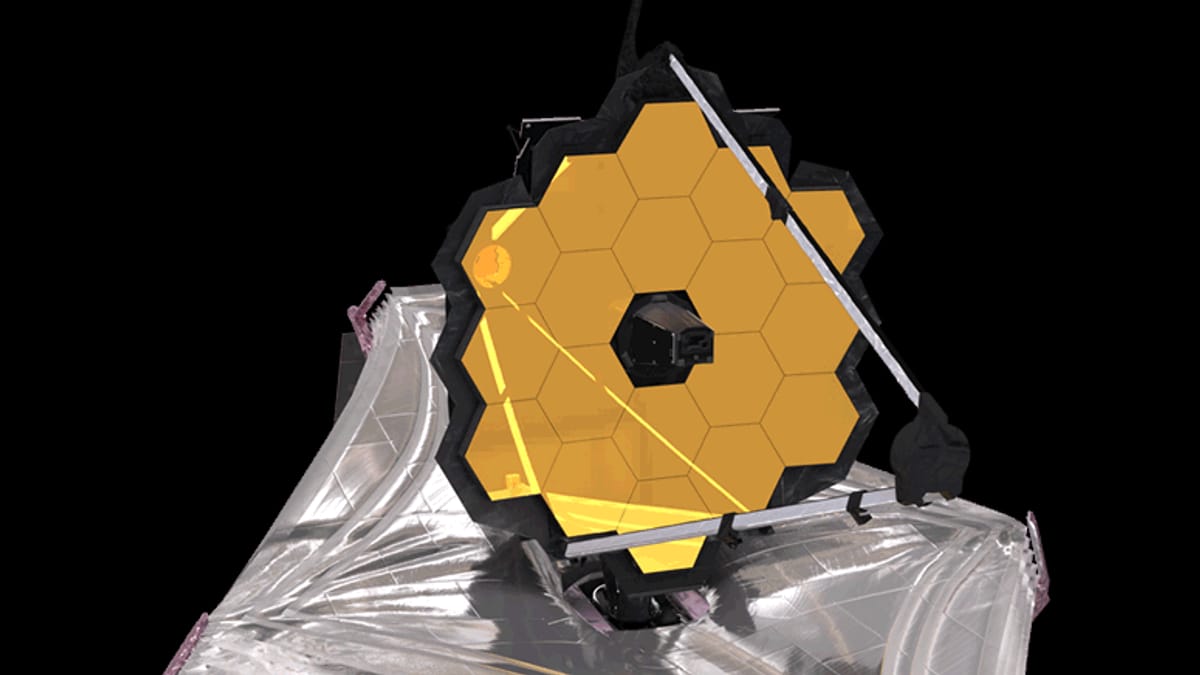
In brief: The James Webb Space Telescope (JWST) is the largest and most powerful telescope ever sent into space. Built by NASA with the European Space Agency and the Canadian Space Agency, it launched on 25 December 2021 and released its first science images in July 2022. It observes in infrared light, allowing it to see the first galaxies formed after the Big Bang, peer through dust clouds where stars are born and study the atmospheres of planets around other stars.
Why infrared?
Light from the most distant galaxies has travelled for more than 13 billion years. As the universe expands, that light is stretched into longer, infrared wavelengths, a process called redshift. Infrared also passes through cosmic dust that blocks visible light. To detect faint infrared signals, the telescope must be extremely cold, so it is protected from the heat of the Sun, Earth and Moon by a sunshield the size of a tennis court.
The telescope
- Mirror: 6.5 metres across, made of 18 hexagonal segments of beryllium coated with a thin layer of gold, which reflects infrared light well. It is far larger than the 2.4 metre mirror of the Hubble Space Telescope.
- Folding design: the mirror and the five-layer sunshield were too large for any rocket and were folded for launch, then unfolded in space in a complex sequence over two weeks.
- Location: Webb orbits the Sun around a point called L2, about 1.5 million kilometres from Earth, where it can keep the Sun, Earth and Moon behind its sunshield.
Launch
JWST launched on an Ariane 5 rocket from Kourou in French Guiana. Development took more than two decades and cost around 10 billion US dollars. The launch was so precise that the telescope saved fuel, extending its expected life to well beyond its original ten-year goal.
What it has found
- Galaxies that existed only a few hundred million years after the Big Bang, some brighter and more developed than astronomers expected, challenging models of early galaxy formation.
- Detailed images of star-forming regions such as the Pillars of Creation and the Carina Nebula.
- The first clear detection of carbon dioxide in the atmosphere of a planet outside the solar system, WASP-39b, in 2022.
- New views of planets in our own solar system, including the rings of Neptune.
The name
The telescope is named after James E. Webb, NASA's administrator during the 1960s Apollo era. Some astronomers objected to the name over allegations about discrimination against gay and lesbian employees in the government of that era; a NASA historical investigation in 2022 found no evidence that Webb himself led such efforts, and the name was kept.
Frequently Asked Questions
When was the James Webb Space Telescope launched?
On 25 December 2021, on an Ariane 5 rocket from French Guiana.
How is Webb different from Hubble?
Webb has a much larger mirror and observes mainly in infrared light, allowing it to see older, more distant objects and to look through dust.
Where is the James Webb Space Telescope?
It orbits the Sun near the L2 point, about 1.5 million kilometres from Earth.