

Frida Kahlo: The Life and Art of Mexico's Most Famous Painter
Pain, politics and identity in the self-portraits that made her a global icon.
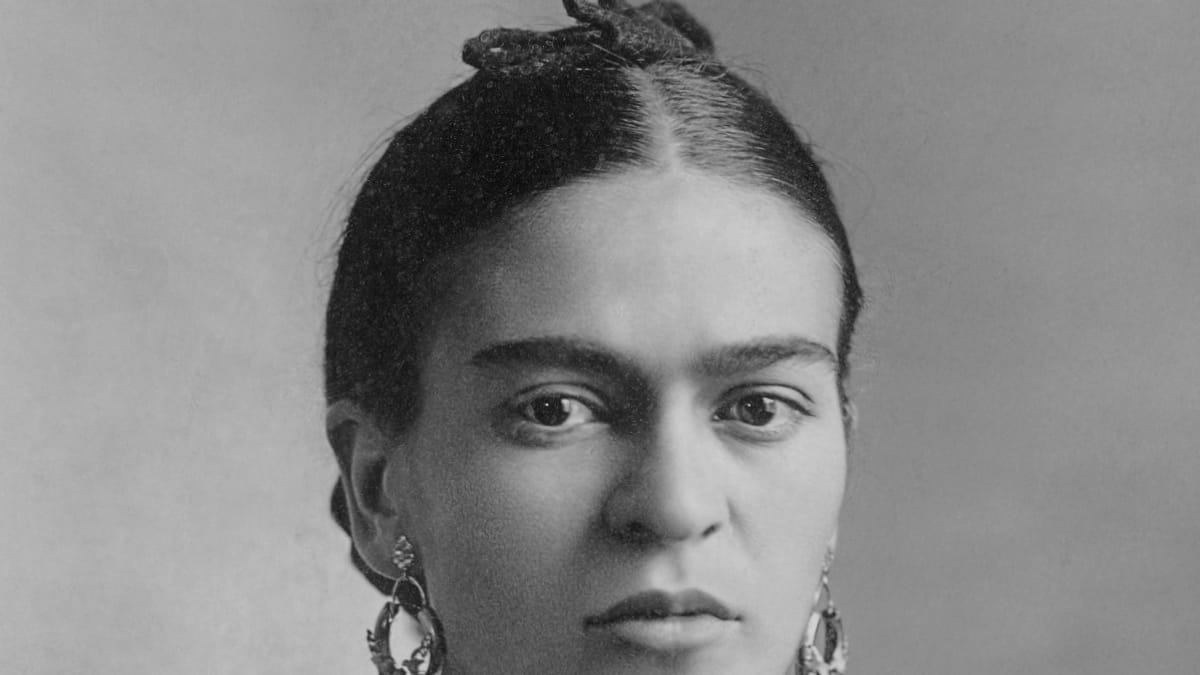
In brief: Frida Kahlo (1907 to 1954) was a Mexican painter known for her vivid self-portraits and works exploring pain, identity, the body and Mexican culture. Severely injured in a bus accident as a teenager, she began painting while confined to bed. Little known outside art circles during her lifetime beyond her marriage to the muralist Diego Rivera, she has since become one of the most celebrated artists of the twentieth century and a feminist icon.
Early life
Magdalena Carmen Frida Kahlo y Calderón was born on 6 July 1907 in Coyoacán, then a town outside Mexico City, in the house later known as La Casa Azul, the Blue House. Her father was a German-born photographer and her mother was of Spanish and Indigenous descent. She contracted polio at six, which left her right leg thinner than the left. She later said she was born in 1910, the year the Mexican Revolution began.
The accident
In September 1925, the bus she was travelling on collided with a streetcar. An iron handrail pierced her body, and she suffered fractures to her spine, pelvis and leg. She spent months in a body cast. Her mother had a special easel made so she could paint in bed, with a mirror above her, and she began painting herself. Throughout her life she endured many operations and chronic pain.
Diego Rivera
Kahlo married Diego Rivera, the famous muralist, in 1929. Their relationship was passionate and turbulent, marked by infidelities on both sides. They divorced in 1939 and remarried in 1940. Both were committed communists, and in 1937 they hosted the exiled Russian revolutionary Leon Trotsky at the Blue House.
Her art
Of her roughly 200 paintings, drawings and sketches, a large share are self-portraits. "I paint myself because I am so often alone and because I am the subject I know best," she said. Her works, such as The Two Fridas (1939) and The Broken Column (1944), combine personal suffering with Mexican folk art, Indigenous traditions and symbolism. In 1939 the Louvre acquired her painting The Frame, making her the first twentieth century Mexican artist in its collection. Her first solo exhibition in Mexico took place in 1953; she attended the opening in her bed, which was carried into the gallery.
Identity
Kahlo often wore traditional Tehuana dress from southern Mexico, embracing Indigenous Mexican identity at a time of national cultural revival. She openly depicted subjects such as miscarriage, disability and the female body, which were rarely painted by women at the time.
Death and legacy
She died at the Blue House on 13 July 1954, aged 47. The house became the Frida Kahlo Museum in 1958 and is one of the most visited museums in Mexico City. Since the 1970s, interest in her life and work has grown enormously, and her image appears worldwide, though some critics argue that commercialisation has obscured the radical politics and pain at the heart of her art.
Frequently Asked Questions
Why did Frida Kahlo paint so many self-portraits?
She began painting while bedridden after a bus accident, using a mirror, and said she painted herself because she was often alone and was the subject she knew best.
Where is the Frida Kahlo Museum?
In La Casa Azul, the Blue House, in Coyoacán, Mexico City, where she was born and died.